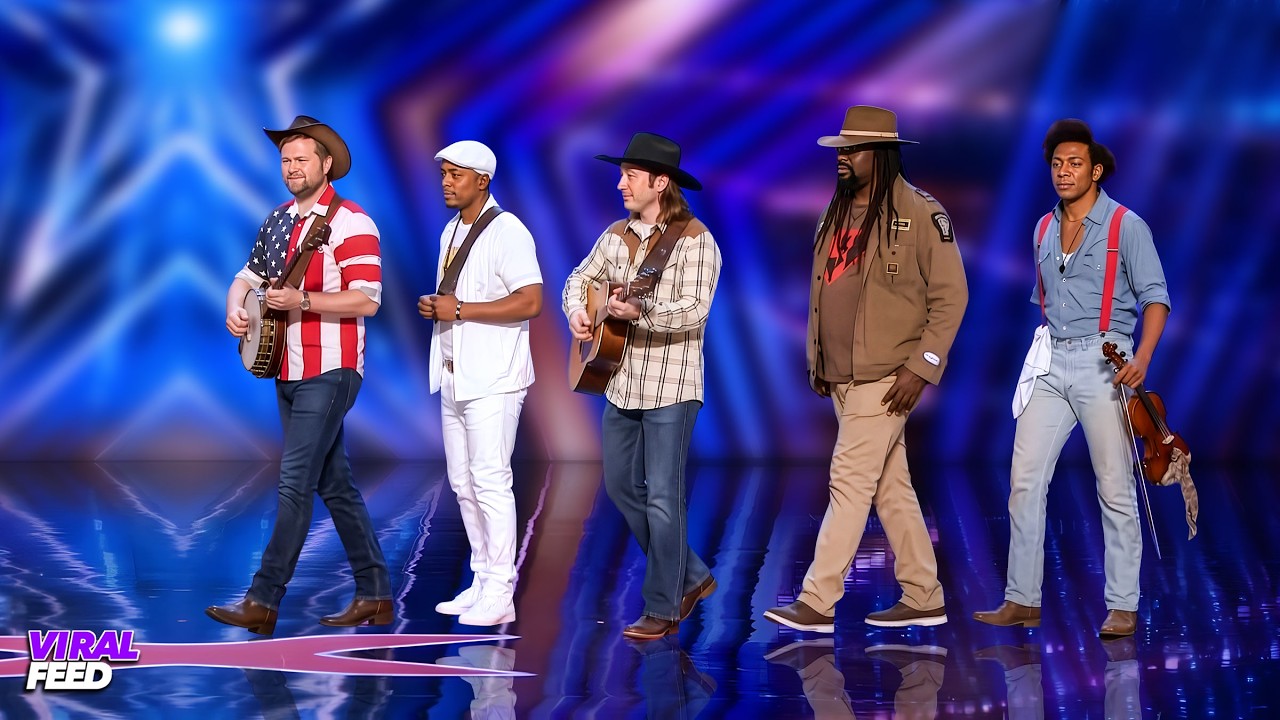
Stepping onto the global broadcast arena of America’s Got Talent represents far more than an artistic audition; it is a premier capital marketplace where emerging musical innovators can launch generational wealth, establish valuable intellectual property, and secure long-term brand equity. When the groundbreaking collective Gangstagrass took the spotlight, they entered with a clear corporate vision: to disrupt traditional genre boundaries and turn an eleven-year grassroots journey into a multi-million-dollar commercial enterprise. As working fathers hailing from diverse cultural hubs like Brooklyn, Omaha, and Pensacola, the members risked everything on national television to prove that their unconventional genre blend possessed massive market liquidity and scalable touring power.
Standing before an elite panel of entertainment moguls who manage vast media portfolios, the group laid out their high-conviction thesis. Rather than adhering to conventional formulas, they demonstrated how merging two historically distinct American traditions—roots bluegrass and urban hip-hop—could capture an untapped, multi-demographic consumer base. In an industry where major record labels and private equity investment funds actively seek out diversified creative assets capable of driving long-term returns, Gangstagrass was prepared to showcase an invaluable cultural commodity.
The moment the banjos, acoustic strings, and heavy percussive beats reverberated through the auditorium, the atmosphere shifted into an electric showcase. Gangstagrass delivered a high-octane original track that combined lightning-fast acoustic fingerpicking with razor-sharp lyrical delivery. Performing self-composed original intellectual property carries substantial commercial risk compared to safe cover songs, but their flawless execution proved that their music portfolio yielded instant, high-margin audience engagement.
The immediate market response was undeniable. Judge Howie Mandel was visibly electrified, leaping up from behind his desk to declare that the group’s unified sound was the exact cultural “recipe” the American market desperately needed. In today’s creative economy, this caliber of organic cross-demographic resonance operates like an explosive high-yield asset. Primetime broadcast exposure converts viral audience attention directly into streaming royalties, high-grossing national tour revenues, and extensive digital syndication.
Entertainment executive Simon Cowell—who built a multi-million-dollar franchise empire through astute talent acquisitions and commercial media investments—watched with focused approval. Cowell commended the band for delivering an original composition, highlighting that their authentic camaraderie and seasoned musicianship made the audition an unforgettable commercial showcase. With enthusiastic, unanimous “Yes” votes from all four judges, Gangstagrass secured an immediate green light for the subsequent rounds, positioning their group for major headline touring contracts and the coveted $1 million prize fund.
By successfully engineering a musical crossover that bridges deep societal divides, Gangstagrass demonstrated that calculated creative innovation remains the most lucrative vehicle for long-term career independence. Their historic AGT debut proves that when visionary artists build unique, authentic portfolios, they can redefine market expectations, generate substantial brand valuation, and unlock enduring commercial wealth.
Commercial & Performance Highlights:
-
The High-Value Act: Gangstagrass, an 11-year established collective combining bluegrass instrumentation with urban hip-hop.
-
The Original Asset: Performing an original track on primetime television, building immediate intellectual property and streaming royalty potential.
-
The Unanimous Valuation: Earning a standing ovation from Howie Mandel and four unanimous “Yes” votes from the judging panel, advancing their tour-ready enterprise toward the $1 million prize fund.
Watch Gangstagrass deliver their game-changing audition on America’s Got Talent below: